

Weather seals can help limit water, dust, pests, and air leakage around the door. Their effect on comfort and energy use depends on the complete garage envelope, climate, sun exposure, conditioning, adjacent rooms, and the condition of the door and opening. Match replacement seals to the exact door and track or retainer; energy savings are not guaranteed. For a model-specific inspection of the door, seals, and operating system, review our garage door maintenance in San Antonio service.
What Is Garage Door Weather Stripping?
Garage-door weather stripping is the flexible sealing material fitted at compatible bottom, side, and top locations. The profiles and retainers vary by door model and opening.
Correctly fitted seals can limit air, water, dust, and pest infiltration, but they do not make every garage weather-tight. Identify the door, retainer, dimensions, and manufacturer-approved profile before selecting a replacement.
Types of Garage Door Seal Materials You Should Know
Seal material affects flexibility, compression, exposure resistance, maintenance, and compatibility. Compare the actual door material and construction, retainer or mounting method, floor and jamb conditions, climate exposure, and the seal manufacturer’s specifications. Choose the compatible profile for the opening rather than relying on one material label.
Rubber and Vinyl Weather Seal Options
Rubber, vinyl, and thermoplastic seal products are available in different profiles and compounds. Their flexibility, temperature range, moisture resistance, compression, and service life vary by manufacturer and application.
Confirm the exact profile, retainer, dimensions, exposure rating, and installation instructions; do not assume rubber is always best for one climate or vinyl for another.
Metal and Aluminum Weatherstripping Choices
Metal-backed weather seals can be durable in suitable applications, but performance and service life depend on the material, exposure, fastening, compression, fit, and maintenance.
They require precise selection and installation; compare the manufacturer’s specifications with the door and opening.
Signs It's Time to Replace Your Garage Door Weather Stripping
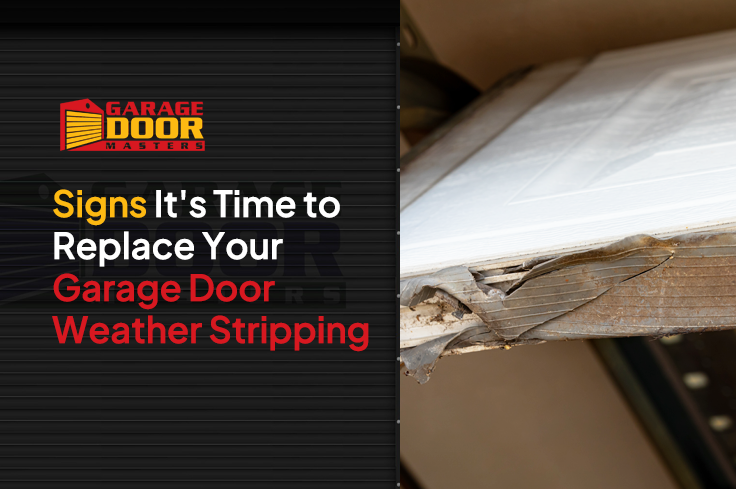
A seal problem can have more than one visible or operational sign.
Possible signs include:
- Visible cracks or tears.
- Flattening or gaps.
- Daylight at the closed perimeter.
- New water, dust, or pest entry.
- A seal that has pulled from its retainer.
Water and temperature changes can also have other causes, so inspect the complete closed opening. Do not work on a moving, unstable, crooked, or damaged door; arrange trained service when the seal, retainer, track, or door condition is uncertain.
How to Install Garage Door Weatherstripping the Right Way
Replacement method depends on the exact door, seal profile, retainer, fasteners, and manufacturer instructions. Perform only an owner task expressly described in those instructions, with the door fully closed, stable, and the work area clear.
Do not remove or loosen tracks, brackets, hinges, bottom fixtures, cables, springs, or other structural or high-tension hardware.
If the seal is trapped by hardware, the retainer is damaged, or the door is unreliable, use trained service.
How Weather Seal Helps Insulate Your Space
Good perimeter and bottom seals can reduce air, water, dust, and pest infiltration.
Heat transfer through the garage still depends on the door, walls, ceiling, gaps, sun exposure, climate, and whether the space is conditioned.
Sealing may improve comfort in some garages, but no whole-house energy saving is guaranteed.
Keep Your Home Protected with Quality Garage Door Weather Stripping
Compatible weather seals can help limit gaps around a sound, correctly installed door, but they do not guarantee energy savings, comfort, or protection from every weather condition.
Inspect the perimeter and bottom seal with the door fully closed, compare replacement parts with the door and retainer documentation, and address damaged sections, tracks, balance, or opening conditions before treating the seal as the complete solution. Our garage-door service guide explains how the whole system is evaluated.

Our Experts Are Here To Help
Get a Free Estimate
Q: How long does garage door weather stripping typically last?
A: There is no universal three-to-five-year service life. Durability depends on the exact material and profile, compression, use, sunlight, temperature, moisture, chemicals, floor and opening condition, installation, and maintenance. Follow the manufacturer’s inspection guidance and replace a compatible seal when it is cracked, torn, permanently flattened, detached, or no longer fitting the opening.
Q: Can I install weather stripping on any type of garage door?
A: Not every seal fits every door. Sectional, rolling, swing, and other door systems use different profiles, retainers, clearances, and movement paths. Identify the exact door and existing retainer, measure as the manufacturer directs, and confirm material and part compatibility before purchase. Do not drill or modify the door or structural hardware without manufacturer approval.
Q: What's the difference between bottom seals and side seals?
A: A bottom seal closes the interface between the moving door and the floor and must match the door’s bottom retainer or approved attachment. Side and top seals are fitted at the jambs and header to contact the closed door without obstructing travel. Each location uses a compatible profile, compression, and installation method; one seal type is not interchangeable everywhere.
Q: Will new weather stripping help with garage noise?
A: Closing perimeter gaps may reduce some air movement and sound leakage, but the result depends on the complete door, seals, walls, ceiling, openings, construction, and sound source. Weather stripping is not soundproofing, and a quieter garage is not guaranteed. Diagnose rattling, grinding, or popping as a door or opener issue rather than trying to mask it with seals.
Q: Should I hire a professional or do this myself?
A: Use the door and seal manufacturers’ instructions to decide whether replacement is an owner task. A simple accessible seal on a fully closed, stable door may be owner-serviceable when the manual provides the procedure. Use trained service when the door is heavy, crooked, damaged, or unreliable; the retainer or hardware is damaged; or work would involve tracks, brackets, bottom fixtures, cables, springs, structural fasteners, or electrical components.
Q: How much does weather stripping replacement cost?
A: Cost depends on the door dimensions, seal profile and material, retainer condition, manufacturer compatibility, removal, surface or retainer work, access, fitting, and labor. Request a written estimate for the actual opening and scope. Do not assume one material always costs more, lasts longer, or fits every standard residential door.