

Garage-door insulation can reduce heat transfer through the door, but its effect on comfort and energy use depends on the complete door assembly, perimeter air leakage, garage use, climate, and whether the garage adjoins conditioned space. The safest option is a factory-insulated door or a retrofit kit approved for the exact door; added material and weight can affect balance, hardware, opener settings, wind performance, and warranty coverage.
Potential benefits of an approved insulated door or retrofit include:
- Reduced panel heat transfer: Compatible insulation can slow conductive heat flow through the door sections.
- More stable garage temperatures: Results depend on the complete assembly, perimeter leakage, glazing, exposure, climate, and garage use.
- Less panel vibration and outside noise: The effect varies by door construction and installation.
- Added panel rigidity: Certain multilayer factory constructions are more rigid, but insulation alone does not guarantee durability.
Insulation does not make a garage airtight or safe to occupy while a vehicle or fuel-burning equipment is operating, and it is not an indoor-air-quality measure. Evaluate perimeter gaps, shared walls and ceilings, ventilation, and air sealing between an attached garage and living space separately.
Types of Garage Door Insulation
Compare only factory-insulated constructions or retrofit materials that the door manufacturer approves for the exact model, attachment method, clearances, and added weight.
- Factory polystyrene sections
Rigid polystyrene cores are used in some manufactured door sections. Compare the complete section construction and reported thermal performance. - Factory polyurethane sections
Polyurethane is commonly injected during manufacture. Do not assume it can be added safely to an existing door after production. - Approved fitted-foam kits
Some manufacturers provide model-specific kits with documented panels, fasteners, clearances, and weight limits. - Approved reflective kits
Reflective products primarily address radiant heat when installed with the air space required by the tested assembly. They should not be compared with foam by thickness alone.
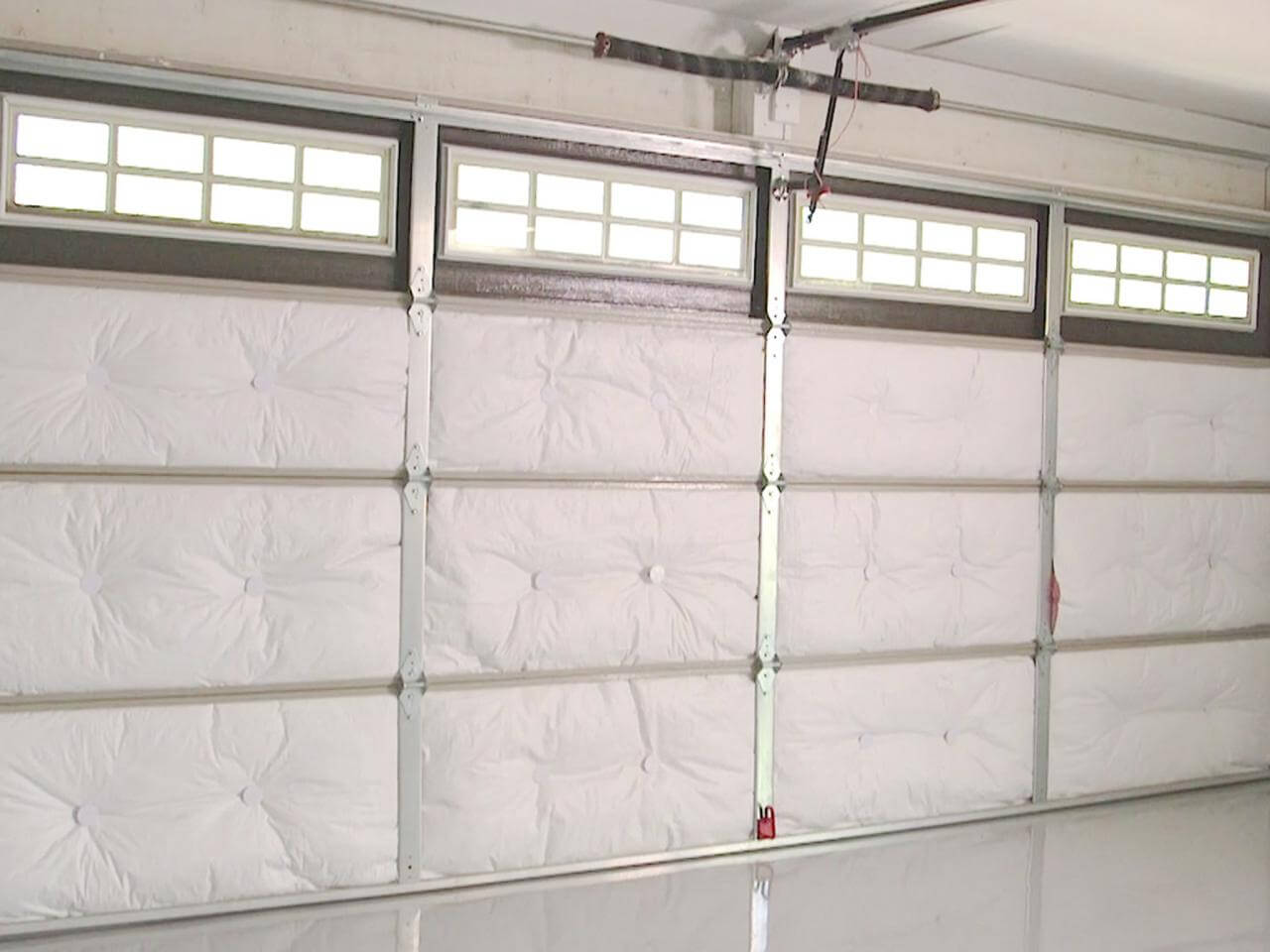
Check Compatibility Before Adding Insulation
Safety and Product Requirements
Before adding insulation: Confirm that the door manufacturer approves the material, attachment method, and added weight. Insulation can change door balance, spring load, hardware stress, opener settings, wind performance, and warranty coverage. Do not modify a damaged or unbalanced door. A trained technician should evaluate compatibility before installation.
If the manufacturer approves an owner-installed kit, follow its instructions exactly for measuring, cutting, fastening, clearances, and final inspection. Stop if the door binds, becomes heavy, or moves unevenly.
Maintenance Tips for Insulated Garage Doors
Inspect approved insulation periodically for sagging, moisture, loose fasteners, or interference with hinges, rollers, tracks, locks, or seals. Clean it according to the material manufacturer’s instructions. Follow the door and opener manuals for any approved lubrication; do not grease tracks or touch springs and cables.
When to Call a Professional
Use only a kit that the door manufacturer approves for the exact model, including its material, fastening method, clearances, and added weight. If the door is damaged, heavy, uneven, unbalanced, or missing clear product documentation, stop and have the complete system evaluated before adding insulation.
When Professional Evaluation Helps
If the manufacturer does not identify an approved owner-installed kit—or if the door is damaged, heavy, uneven, or unbalanced—have the system evaluated before adding material.
A professional should verify the door model, construction, available clearances, approved attachment method, added weight, balance, hardware condition, opener compatibility, and warranty requirements. When retrofit is not appropriate, a factory-insulated replacement may be the safer and more predictable option.